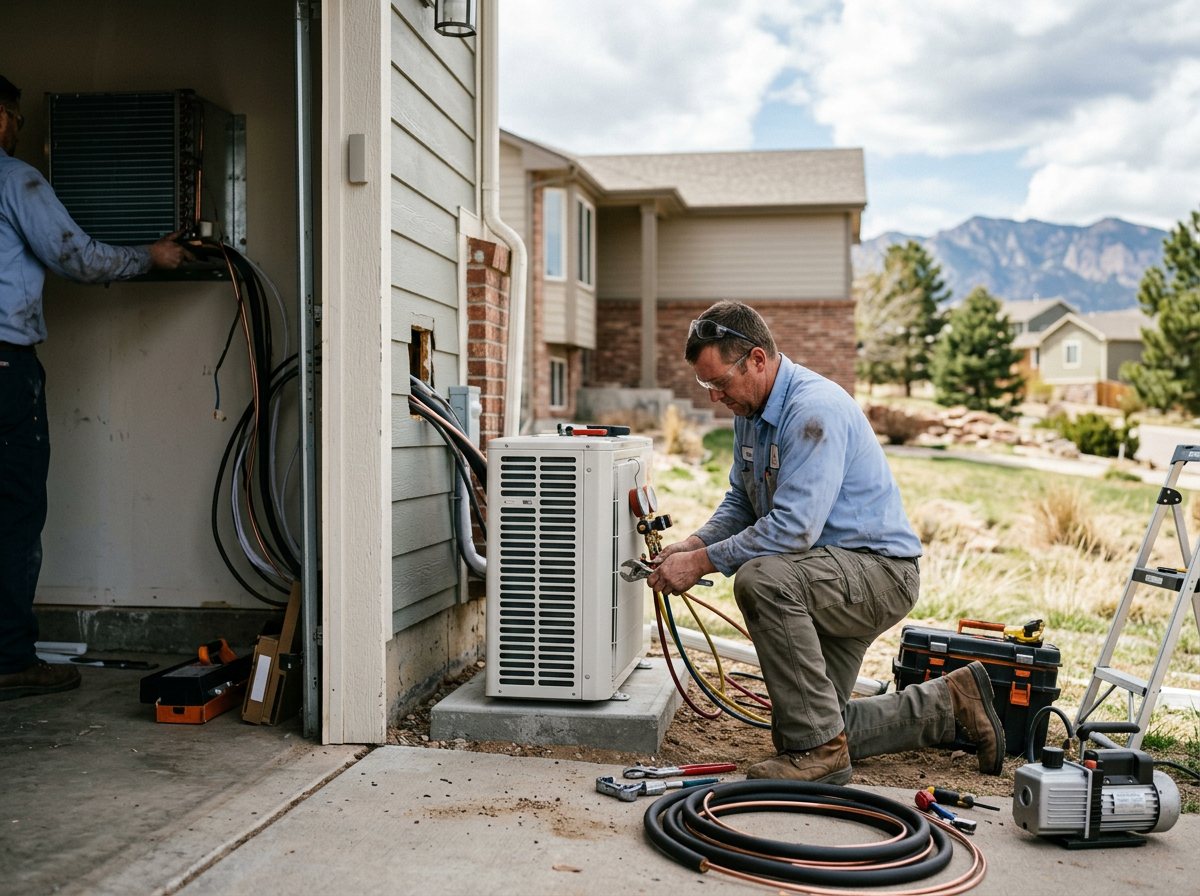
At 6,035 feet, heat pump heating capacity drops roughly 4 percent per thousand feet above 2,000, so technicians must select larger coils or variable-speed compressors and verify orifice or firmware changes before startup. Combustion air and draft issues common with gas furnaces do not apply, yet refrigerant charge calculations still shift because lower air density changes airflow across the outdoor coil. Homes in Security-Widefield and Cimarron Hills often have undersized return ducts from the 1970s that must be enlarged to prevent short cycling when chinook winds cause rapid 30-degree temperature swings.
Diagnostic sequence begins with Manual J load calculation adjusted for elevation, followed by static pressure readings on existing duct runs in Old North End and Old Colorado City houses where hard turns and small chases limit airflow. Outdoor units are mounted on hail-rated stands because El Paso County storms flatten fins and raise head pressure, shortening compressor life. Indoor air handlers receive auxiliary heat strips sized for the coldest design day, not just the 95 percent bin, because dry winter air at this altitude strips humidity and leaves occupants cold even when the thermostat is satisfied.
Newer Briargate and Wolf Ranch builds allow easier placement of high-efficiency units with communicating thermostats, yet even these require condensate drains sloped for rapid freeze-thaw cycles. Pre-war homes need line-set routing that avoids unconditioned crawl spaces where pipes sweat and ice in winter. Every installation includes a final check of defrost cycles under low-ambient conditions, because standard factory settings often cause unnecessary auxiliary heat calls during the long cold nights common above 6,000 feet.
Technicians always verify breaker and wire sizing against the nameplate minimum circuit ampacity after derating tables are applied; undersized feeders overheat during extended auxiliary heat operation triggered by sudden temperature drops. Final commissioning includes measuring supply-air temperature split at both high and low fan speeds to confirm the system will not short-cycle when afternoon sun raises outdoor temperatures 20 degrees in an hour.
Technician insight
In Colorado Springs the thing that catches most people out with heat pump installation is undersized return ducts in 1970s Security-Widefield homes; the system short-cycles the first time a chinook wind swings the temperature 30 degrees in an afternoon and the auxiliary strips never shut off.
Briargate ranch with undersized returns
Homeowner reported high electric bills and cool rooms after installing a heat pump sized for sea level. We found the original 1970s returns could not deliver required airflow at altitude. Ducts were enlarged, a variable-speed unit with proper derated capacity was installed, and auxiliary strips were added; the system now maintains temperature through rapid swings without excessive runtime.
Heat Pump Installation Services We Offer
✓High-Altitude Heat Pump Sizing
Manual J calculations adjusted for 6,035 ft elevation and derated capacity ensure the system meets design loads without excessive auxiliary heat use.
✓Duct Modifications for Heat Pumps
Existing 1970s-80s duct runs in Security-Widefield and Cimarron Hills homes are enlarged or sealed to support proper airflow and prevent short cycling during rapid temperature swings.
✓Hail-Protected Outdoor Unit Installation
Condensers are mounted on reinforced stands with hail guards to protect fins from El Paso County storms that raise head pressure and shorten equipment life.
✓Ductless Mini-Split Heat Pump Systems
Multi-zone indoor heads installed in older homes with difficult duct routing provide zoned comfort without major structural changes.
✓Auxiliary Heat Strip Integration
Properly sized electric heat strips are added to handle design-day loads and rapid temperature drops common during chinook wind events.
Heat Pump Installation Cost in Colorado Springs, CO
| Service | Typical Range | What Affects It |
|---|---|---|
| Standard 3-ton heat pump installation | $5,800–$8,200 | Newer homes with adequate ducts and 240 V service |
| Duct modifications | $1,200–$3,500 | Common in 1970s-80s tract homes with undersized returns |
| Auxiliary heat strip addition | $650–$1,100 | Required for design-day loads at altitude |
| Electrical service upgrade | $900–$2,400 | When existing panel or wiring cannot support the unit |
Ranges are typical for Colorado Springs, CO and confirmed with an exact written quote before any work starts.
How it works
- 1
Site Assessment And Load Calculation
Elevation-adjusted Manual J is performed on-site, noting duct condition, insulation levels, and window orientation.
- 2
Equipment Selection
Units are chosen with capacity that accounts for altitude derating and compatibility with existing electrical service.
- 3
Duct And Electrical Preparation
Returns are modified if needed and breakers or disconnects are upgraded to meet nameplate requirements after derating.
- 4
Installation And Charging
Line sets are run, the system is pressure-tested, evacuated, and charged per manufacturer tables adjusted for elevation.
- 5
Commissioning And Owner Walkthrough
Defrost cycles, auxiliary heat operation, and thermostat settings are verified under local temperature conditions.
Pricing
Pricing depends on system size, required duct changes, and whether auxiliary heat or electrical upgrades are needed.