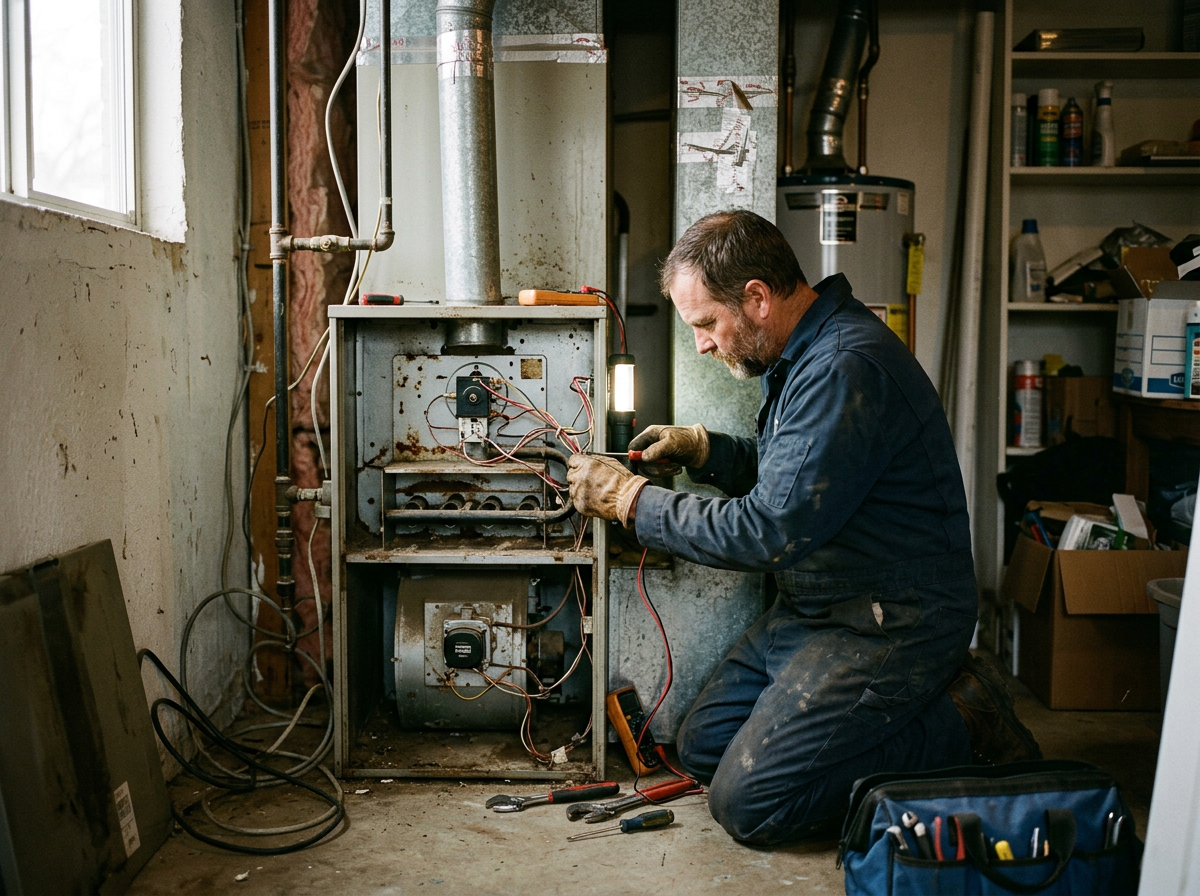
At 6,035 ft, gas furnaces lose roughly 4 percent output per thousand feet above 2,000 ft, so combustion air, orifice sizing, and draft inducer performance must be checked on every call. Older Security-Widefield and Cimarron Hills units often still have the original high-altitude kits that have drifted out of spec, while newer Briargate and Wolf Ranch models require updated ECM blower programming to avoid short cycling during the 30-to-40-degree daily swings common here. A technician first verifies manifold pressure with a manometer, then inspects the flame for lifting or yellow tipping caused by reduced oxygen density before touching any other component.
Temperature swings and chinook winds create repeated thermal stress that cracks heat exchangers in pre-war Old North End homes with rigid duct runs and in 1980s tract homes with flex duct that collapses under negative pressure. Dry winter air also accelerates dust buildup on the blower wheel and secondary heat exchanger, raising operating temperatures and tripping limit switches. Diagnosis starts with a combustion analysis, followed by static pressure readings across the filter and coil, then a visual inspection of the exchanger with a mirror and flashlight before any parts are ordered.
When a furnace fails to ignite, the sequence is always the same: confirm 24-volt power to the control board, test the pressure switch and rollout switches for altitude-related draft issues, then check the hot-surface igniter resistance and flame sensor microamp reading. In Manitou Springs and Monument homes above 6,400 ft, technicians carry both standard and high-altitude orifices on the truck because swapping the wrong kit immediately voids efficiency ratings. Never attempt to clean a flame sensor with sandpaper; use a non-abrasive pad and replace it if the reading stays below 0.5 microamps.
Parts that commonly fail here include the draft inducer motor, which works harder against thinner air, and the gas valve, which can stick when dust from dry chinook winds enters the supply line. After any repair the system is run through at least two full cycles while monitoring stack temperature and CO levels to confirm safe operation at local elevation. Homeowners are shown the failed part and the pressure readings so they understand why the repair was required rather than simply being told the furnace needed service.
Get a Free Furnace Repair Quote
Call (719) 642-1738 any time, including weekends and holidays. Tell us your zip code and what the furnace is doing, and you will be connected with a local Colorado Springs technician who can quote the work. Most no-heat calls in the Pikes Peak region are answered the same day.
Technician insight
In Colorado Springs the thing that catches most people out with Furnace Repair is assuming a 1985 Security-Widefield unit can run on the same orifice and manifold pressure it had when installed; the thin air at 6,035 ft plus chinook wind cycling cracks exchangers faster than most homeowners expect, and skipping the combustion test after a repair is how you end up with a callback two weeks later.
Short Cycling After Chinook Winds in Briargate
A 2018 high-efficiency furnace in a Briargate home began short cycling during a 35-degree temperature swing. Static pressure readings showed the ECM blower was ramping too aggressively for the thinner air; the pressure switch was barely making. We adjusted the blower profile, replaced the drifted high-altitude orifice, and verified proper manifold pressure and CO levels. The unit now completes full cycles without tripping.
Furnace Repair Services We Offer
✓High Altitude Burner Adjustment
Re-orifice and manifold pressure adjustment for Colorado Springs elevation to restore proper combustion and efficiency.
✓Hot Surface Igniter Replacement
Direct replacement of failed igniters with altitude-rated units that withstand repeated thermal cycling from daily temperature swings.
✓Heat Exchanger Inspection
Camera and combustion analysis check for cracks common in 1970s-80s tract homes after years of short cycling.
✓Draft Inducer Motor Repair
Replacement or rebuild of inducer motors stressed by reduced air density at 6,035 ft and higher service-area elevations.
✓Blower Wheel Cleaning and Balance
Removal of dry-air dust buildup that raises amp draw and causes overheating in both older and new high-efficiency furnaces.
✓Flame Sensor and Control Board Service
Microamp testing and board diagnostics that account for low oxygen affecting flame rectification in local conditions.
Furnace Repair Cost in Colorado Springs, CO
| Service | Typical Range | What Affects It |
|---|---|---|
| Diagnostic Visit | $100–$150 | Waived if repair is performed same visit |
| Igniter Replacement | $180–$320 | Varies by model and whether high-altitude kit is needed |
| Draft Inducer Replacement | $350–$650 | Higher in Monument and Woodland Park due to longer drive and parts |
| Heat Exchanger Inspection With Combustion Analysis | $150–$250 | Includes CO and efficiency readings |
| Gas Valve Replacement | $400–$700 | Depends on natural gas or propane and accessibility in older homes |
Ranges are typical for Colorado Springs, CO and confirmed with an exact written quote before any work starts.
How it works
- 1
Initial Safety And Power Check
Verify electrical supply, thermostat demand, and gas pressure before opening the furnace.
- 2
Combustion And Draft Analysis
Measure manifold pressure, CO, and draft at local elevation to identify altitude-related issues.
- 3
Component Testing
Test igniter, flame sensor, pressure switch, and limit switches in sequence.
- 4
Repair And Reassembly
Replace or adjust parts, reinstall panels, and restore proper airflow.
- 5
Cycle Verification
Run the furnace through multiple cycles while monitoring temperatures and emissions.
Pricing
Upfront quote after inspection; most furnace repairs range $250-$850 depending on parts and elevation adjustments required.