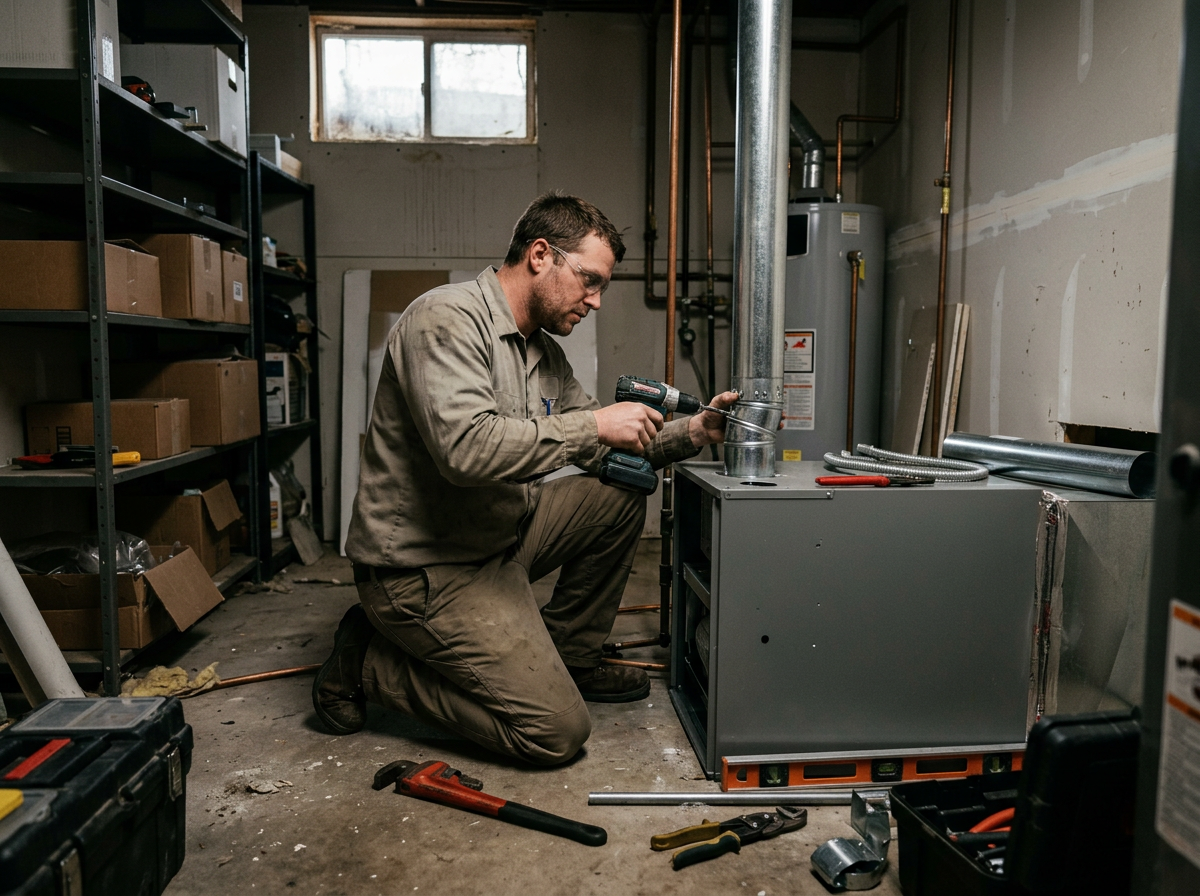
At 6,035 feet, every new furnace must be derated roughly 4 percent per thousand feet above 2,000 feet. Installers swap in high-altitude orifices and adjust the gas valve so the unit does not over-fire or produce excessive CO. Without these changes the heat exchanger runs hot, shortens its life, and trips safety limits during the first cold snap.
Daily 30- to 40-degree swings and chinook winds cause short cycling on oversized single-stage units. We measure actual heat loss on site, then select two-stage or modulating equipment that matches the load of 1970s Security-Widefield tract homes or the tighter envelopes in Briargate new builds. Proper duct sealing prevents the negative pressure that pulls combustion air from living spaces in older hard-piped systems.
Pre-war Old North End and Old Colorado City homes often have rigid metal ducts routed through tight joist bays. We pull permits, verify flue sizing for the derated input, and add combustion-air openings sized to code before the unit is set. Skipping these steps is the most common reason an installation fails the first El Paso County inspection.
After the furnace is fired we perform a combustion analysis at both high and low fire, check draft under worst-case conditions with the dryer and bath fans running, and verify that condensate drains remain clear during the dry winter months when humidification is added.
Technician insight
In Colorado Springs the thing that catches most people out with furnace installation is skipping the combustion-air calculation on older homes in Old Colorado City. Those tight basements with one small window well never supply enough air once the new high-efficiency unit starts pulling draft, and the first cold chinook wind exposes it fast.
Security-Widefield 1982 Ranch
Homeowner’s 30-year-old furnace short-cycled every time the temperature dropped after a chinook. We found the original single-stage unit was oversized for the now-better-insulated home and lacked high-altitude orifices. After installing a properly derated two-stage furnace and sealing the existing ducts we achieved steady 15-minute run times and passed the county inspection the same day.
Furnace Installation Services We Offer
✓High Altitude Furnace Derating
Install high-altitude orifice kits and recalibrate gas pressure so the furnace delivers rated output without over-firing at 6,035 feet.
✓Two-Stage Furnace Installation
Replace single-stage units with two-stage models that handle daily temperature swings without short cycling in Colorado Springs tract homes.
✓Modulating Furnace Installation
Fit variable-capacity furnaces sized to the actual heat load of newer Briargate and Wolf Ranch homes for steady, quiet operation.
✓Old Home Duct Adaptation
Modify rigid duct runs in pre-war Old North End and Old Colorado City houses so new furnaces achieve proper airflow and static pressure.
✓Combustion Air and Venting Upgrade
Add code-compliant combustion-air openings and resize vents to maintain safe draft at local elevation and wind conditions.
✓Humidifier Integration
Install whole-house humidifiers to offset the extremely dry winter air while protecting the new furnace heat exchanger from low-humidity stress.
Furnace Installation Cost in Colorado Springs, CO
| Service | Typical Range | What Affects It |
|---|---|---|
| Standard replacement in tract home | $4,800–$7,200 | Includes high-altitude kit and basic venting; price rises with new line sets or condensate pumps. |
| Modulating furnace in newer construction | $7,500–$10,500 | Larger variable-speed blower and upgraded thermostat add cost. |
| Old-home duct and venting modifications | $1,200–$2,800 | Rigid metal rework and combustion-air openings in pre-war homes. |
| Humidifier added during install | $650–$1,100 | Bypass or powered unit plus water line and drain. |
Ranges are typical for Colorado Springs, CO and confirmed with an exact written quote before any work starts.
How it works
- 1
Load Calculation And Site Survey
Measure actual heat loss, inspect existing ducts, and note elevation-specific requirements for the address.
- 2
Equipment Selection
Choose derated, properly staged equipment matched to the home’s construction era and insulation level.
- 3
Permit And Safety Prep
Pull required permits, size combustion air openings, and confirm flue routing before any demolition begins.
- 4
Installation And Combustion Testing
Set the furnace, connect gas and venting, then run combustion analysis at both firing rates under local wind conditions.
- 5
Final Inspection And Handover
Walk the homeowner through operation, filter changes, and humidifier settings before leaving the job.
Pricing
Final price depends on existing duct condition, required venting changes, and whether a new thermostat or humidifier is added.